Exterior Cleaning Franchises
Exterior cleaning is a crowded franchise category in home services. There is a relatively low barrier to entry (vehicles, equipment) before any licensing and/or permits are required for larger scale work. The core work and the demand are real - there will always be a need for businesses and home owners to maintain their properties. The question is whether the unit economics remain attractive in a given market given competetive dynamics, customer acqusition cost trends, background macro economic factors, and challenges in scaling fragmented services.
This report is designed as a backgrounder that emphasizes the importance of market selection and the operational realities of a franchise in this space. We analyze this through FDD data in brand-by-brand profiles below (investment, territory, marketing model, growth milestones, financial scenarios, and exit terms).
Quick Highlights & Key Issues
- Exterior cleaning offers a clear value proposition and a necessary core service for both residential and commercial customers.
- Unit economic costs are critical to understand - customer acquisition cost and high % of sales marketing spend is required in competetive markets.
- High competition - especially in residential mid-market as there is a relatively low barrier to entry (vehicles, equipment, personel)
- Seasonality, royalty minimums and gross revenue percentages, recurring customer contracts, and required growth targets are important to monitor
Franchise Systems Analyzed
Brands below are included in this sector report. Summary data extracted from 2025 FDDs (for calendar year 2024).
Rolling Suds
ViewPink's Window Services
ViewWindow Hero
ViewSparkle Squad
ViewFish Window Cleaning
ViewShine Window Care & Holiday Lighting
ViewOperator Perspective: Execution Phases and Risk Areas
Starting an exterior cleaning franchise involves multiple execution layers. Some are common to most service businesses, including establishing a website and CRM, hiring and training staff, acquiring vehicles and equipment, securing insurance, and building a basic sales process.
Exterior cleaning also has category specific operational risks that should be evaluated carefully during due diligence. These risks generally fall into three execution phases.
I) Technical and Logistical Ramp Up
- How do I reliably fulfill and service jobs?
Although the capital barrier to entry is relatively low, exterior cleaning is not a generic service. Window cleaning, pressure washing, roof treatments, and surface restoration each require specific techniques, equipment, chemicals, and safety procedures. Surface type, property layout, and access constraints can materially affect job complexity, time on site, and risk exposure.
Much of this proficiency is developed through experience rather than documentation alone. For new franchisees, the early operating phase often includes a learning curve that is effectively subsidized by the operator through lower efficiency, rework, or slower job throughput.
As the business scales, logistics become increasingly important. Vehicle routing, crew utilization, equipment maintenance, chemical handling, and job sequencing all impact margins. One advantage of franchising in this category is access to established operating playbooks, training standards, and quality control systems that can reduce variability and execution risk.
II) Sales Ramp Up
- How do I acquire my first customers?
- How do I build a repeatable sales funnel?
- How quickly and profitably can demand be generated?
Sales and marketing are often the primary constraint in exterior cleaning franchising. Demand exists, but competition is frequently intense, particularly in residential markets with low barriers to entry. Customer acquisition economics tend to determine success more than service quality alone.
Prospective customers generally fall into two broad categories.
Customers who have used exterior cleaning services in the past
These customers already have a reference point. Switching behavior may be driven by dissatisfaction, pricing, or convenience. However, customers who frequently switch providers may also be more price sensitive and harder to retain, placing pressure on margins.
Customers who have never used the service
For first time buyers, differentiation becomes the challenge. In competitive markets, multiple providers often compete through the same channels, including search advertising, local services ads, and marketplaces. The diligence question is whether customers can be acquired profitably, not simply whether they can be acquired.
III) Scaling
- How do operations and sales hold up as additional trucks and crews are added?
- Can quality and safety be maintained while expanding the labor force?
- How does seasonality affect utilization, margins, and cash flow?
- How exposed is the business to job site risk and employee turnover?
Many exterior cleaning businesses perform well at a small scale but struggle to maintain profitability as they grow. Scaling introduces management overhead, labor complexity, and higher marketing spend. Understanding where these pressures emerge is critical before underwriting a multi crew growth plan.
Marketing and Competition: Analyzing Customer Acquisition Cost by Channel
Marketing and sales are often the primary constraint in exterior cleaning franchises. This is the area where competitive dynamics become most visible and where unit economics are most likely to deteriorate if assumptions are overly optimistic.
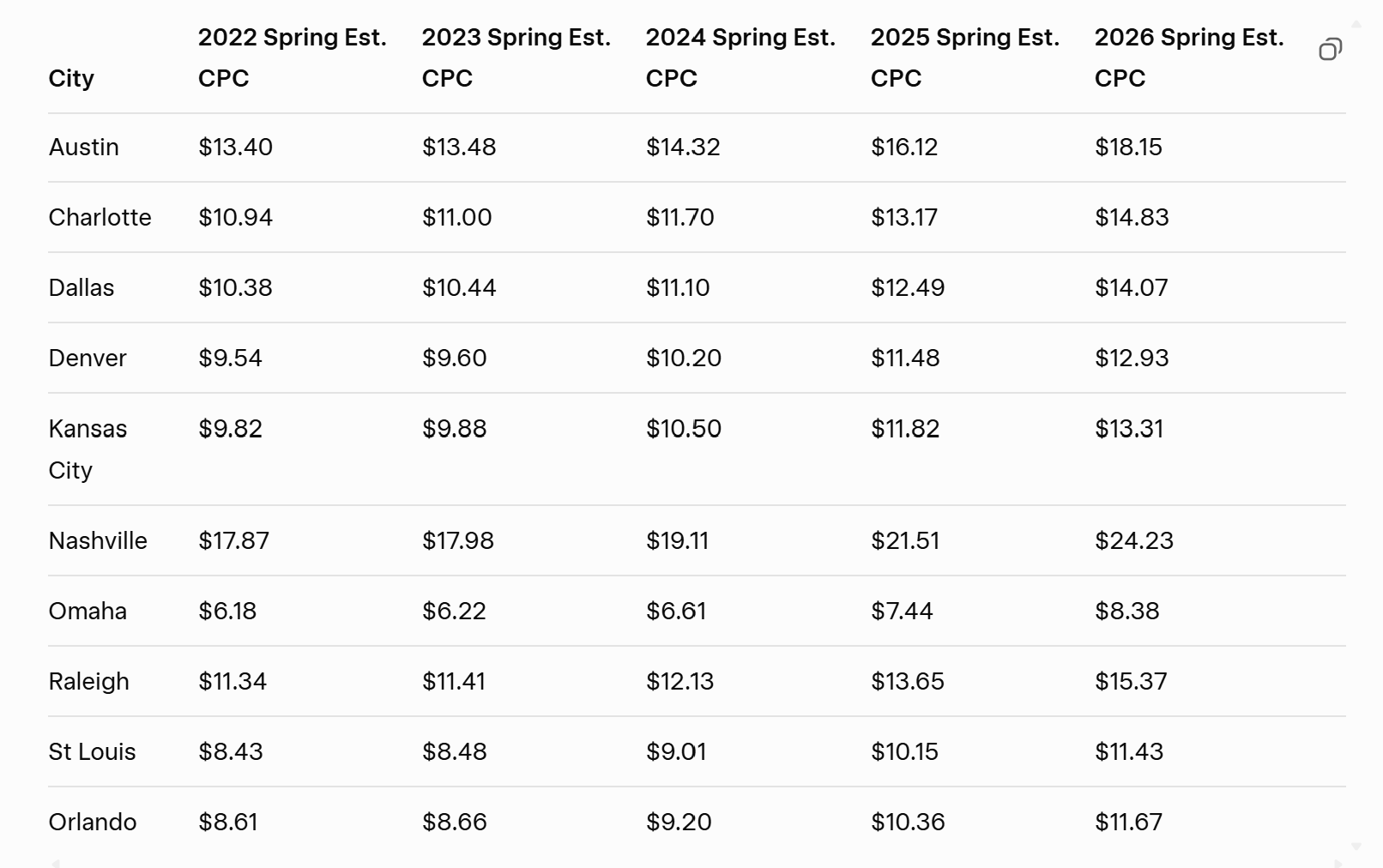
Paid search and pay per click advertising provide a useful reference point for modeling customer acquisition costs. In many markets, cost per click for terms such as pressure washing [city] has increased materially over the past several years. In some locations, CPC growth of 30 to 40 percent has been observed. These figures are directional rather than precise, but they are helpful for stress testing margins.
Using a simplified illustrative example:
- Cost per click: $15
- Click through rate: 8 percent
- Lead to sale conversion rate: 50 percent
- Average job value: $500
Under these assumptions, cost per lead is approximately $187 and customer acquisition cost is approximately $375. Assuming a 30 percent labor rate, the first job generates roughly $525 in labor cost alone. This results in negative contribution margin before accounting for royalties, insurance, vehicles, fuel, technology fees, and other operating expenses.
Even under more favorable assumptions, such as a $10 cost per click, 10 percent click through rate, and 60 percent conversion rate, customer acquisition cost remains approximately $139. While margins improve, they remain highly sensitive to small changes in conversion rates, average ticket size, and marketing efficiency.
Paid search is only one acquisition channel. Local Services Ads, marketplaces, aggregators, referrals, direct mail, and social channels each have distinct cost structures and competitive pressures. Over time, organic lead generation, repeat customers, and referral driven demand are often required to offset rising paid acquisition costs and support sustainable profitability.
Startup Financial Model: Modeling a new Franchise Location
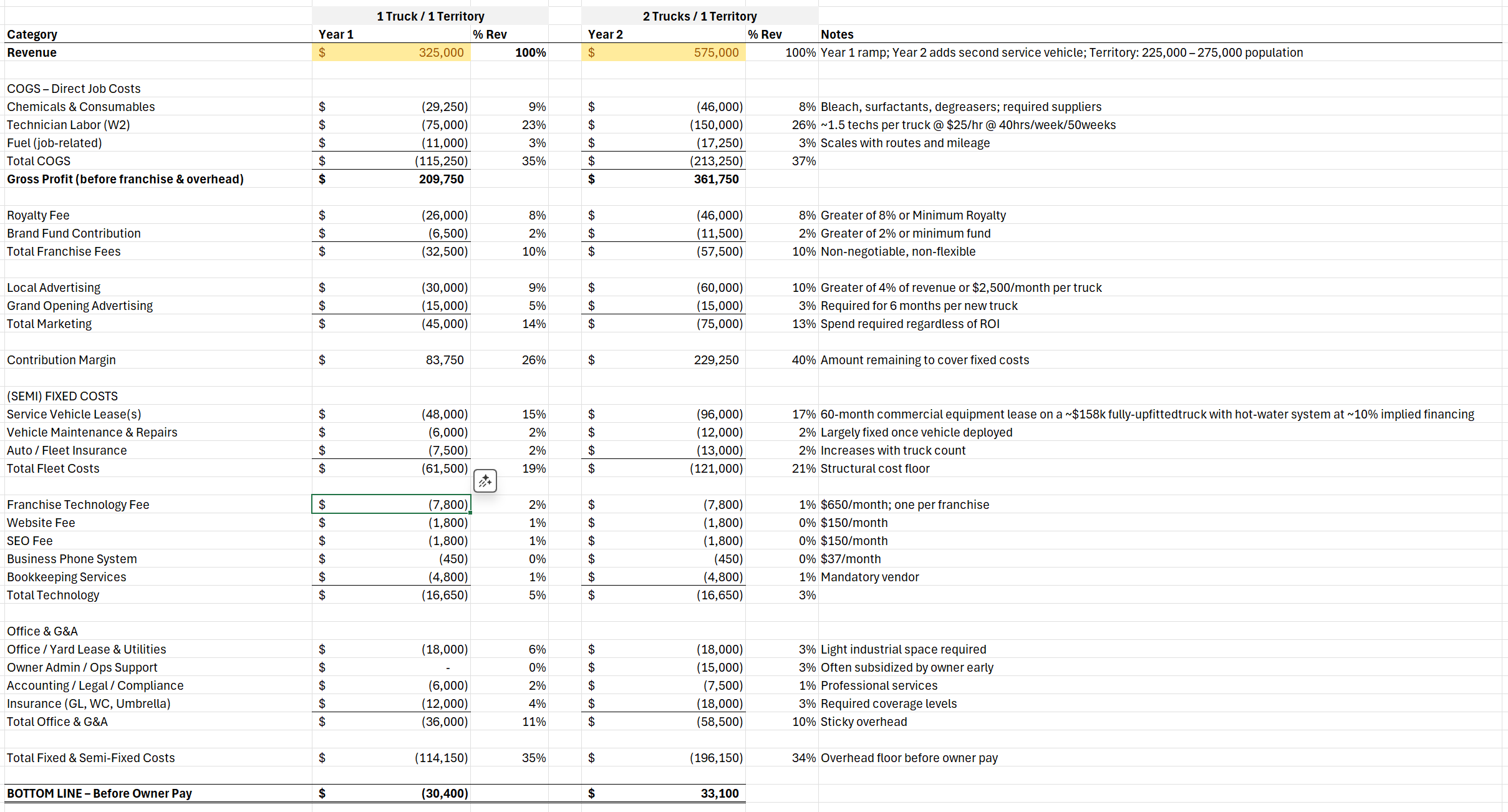
Given the operating realities and importance of marketing spend analysis, below is an example model (for Rolling Suds, two years of startup).
This is a basic model meant to be illustrative of the variable and fixed costs in the franchise model. This is not meant to be comprehensive or prescriptive, but rather a starting point for analysis and discussion.
For any of the brands you are considering, you can use their FDD data to plug in the initial investment, royalty rates, marketing fees, and any other fixed costs. Test important assumptions (truck utilization rates, labor costs, vehicle costs).
Understand your marketing and sales channels (and lead/CAC assumptions in each), mix of residential/commercial, seasonality, ramp time, and various scaling points seen in each FDD and by talking with other franchisees or operators.
Exit Terms: Transfers, Failure, and Liquidated Damages
Exit is where many franchise models get sharp. Transfer fees, renewal conditions, required upgrades, and constraints on buyer qualification can all reduce your ability to sell on your timeline. Liquidated damages clauses can also change the risk profile if you terminate early.
Review Item 17 carefully and conult an attorney about details and also the terms of your franchise agreement (different than the FDD).
Key Questions to Ask Before Signing
Use this category's competetive realities to drive due diligence and understand CAC, sales, marketing, and local market analysis.
- How many direct competitors exist within 10 miles of my core ZIPs? How many have 4.8+ star ratings?
- What channels are competitors using (LSA, PPC, Angi/Thumbtack, direct mail, partnerships)?
- How seasonal is demand locally, and what is the plan for slow months?
- How large are territories and how is population considered in item 19 disclosures?
- What is required local marketing spend, and what additional vendor/tools are mandatory?
- If the franchisor provides leads, are they exclusive, and what happens if quality is poor?
- What CAC assumptions did top franchisees actually experience (not corporate estimates)?
- What breaks first when scaling: hiring, training, dispatch, quality control, or equipment uptime?
- What is a realistic crew utilization target and how quickly can you get there?
- How much rework and warranty cost should be assumed?
- Which fees have minimums regardless of revenue (royalty minimums, tech, brand fund, marketing)?
- Does any disclosed financial performance include owner pay and debt service?
- What are the transfer terms and liquidated damages exposures if I need to exit early?
Summary: What to Evaluate in Exterior Cleaning
Exterior cleaning franchises can succeed, but outcomes are highly sensitive to execution, market selection, and customer acquisition economics. Focus less on headline revenue potential and more on the operational realities of ramp-up, sales efficiency, and scalable unit economics.
Franchise Signal's role is to help you pressure-test the hard numbers using FDDs and consistent comparisons across brands.
Are you researching franchises?
Become a platform member for full access to FDD-backed franchise reports, AI analysis tools, and analytics.
Become a Member